
Digital Signatures in an Analog Procedural Culture
DOI:
https://doi.org/10.35319/lawreview.202618138Keywords:
Digital signature, civil procedural law, public document, electronic evidence, procedural formalismAbstract
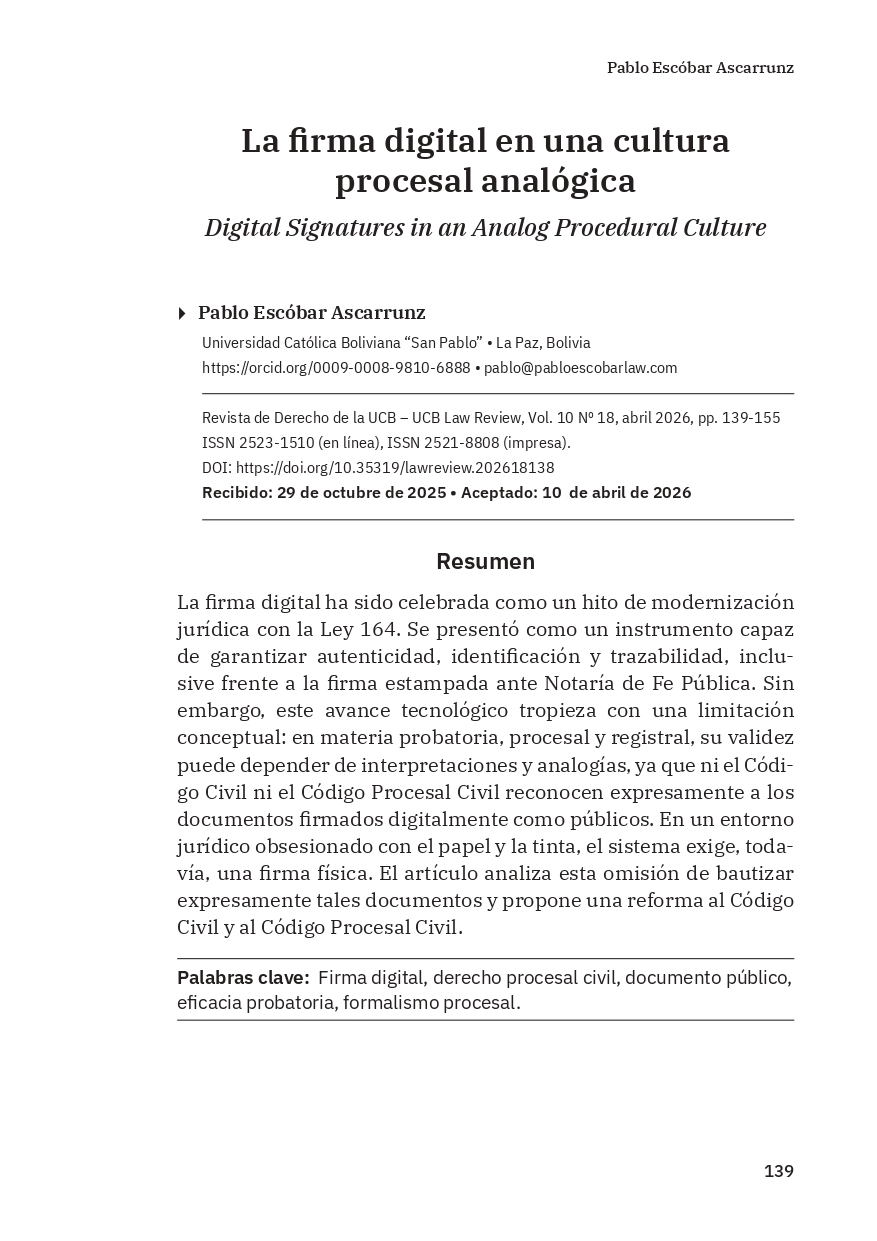
Digital signatures have been celebrated as a milestone in Bolivia's legal modernization following the enactment of Law 164. They were introduced as tools capable of ensuring authenticity, identification and traceability with a level of precision that often exceeds the traditional handwritten signature, even one notarized. Yet this technological advance runs into a classification problem: in evidentiary, procedural and registry matters, its effectiveness often depends on judicial interpretation because neither the Civil Code nor the Rules of Civil Procedure expressly recognizes digitally signed documents as public instruments. In a legal culture where paper instruments retain their presumptive primacy, the system continues to demand a physical signature. This article examines that omission and proposes targeted reforms to align Bolivia's civil and procedural codes with its digital framework.
Downloads
References
Agencia para el Desarrollo de la Sociedad de la Información en Bolivia. (s. f.). Validación de firmas digitales. https://validar.firmadigital.bo
Decreto Ley N° 12760, Código Civil. 6 de agosto de 1975.
Ley N° 164, Ley General de Telecomunicaciones, Tecnologías de Información y Comunicación. 8 de agosto de 2011.
Decreto Supremo N° 1793, Reglamento a la Ley General de Telecomunicaciones, Tecnologías de Información y Comunicación. 13 de noviembre de 2013.
Ley N° 439, Código Procesal Civil. 19 de noviembre de 2013.
Downloads
Published
How to Cite
Issue
Section
License
Copyright (c) 2026 UCB Law Review

This work is licensed under a Creative Commons Attribution-NonCommercial-ShareAlike 4.0 International License.
The U.C.B. Law Review is an Open Access Journal, therefore, it is full free for access, reading, search, dowload, distribution and lawfull reuse in any medium only for non-comercial purposes, provided the original work is properly cited.